18 March 2014

2014 Wandsworth borough elections (1)

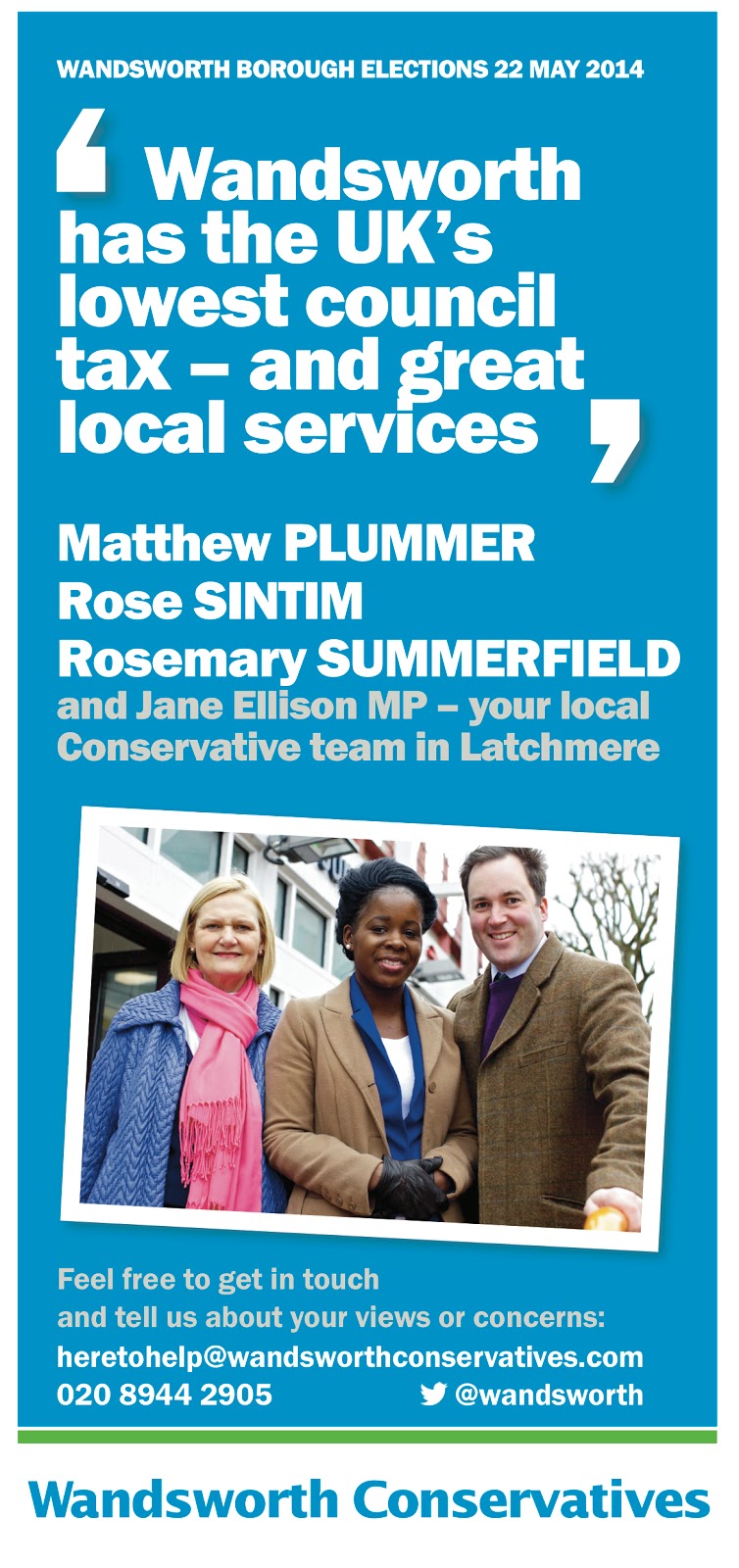
Back in February I was selected to be one of the Tory candidates in Latchmere, a ward in Wandsworth that encompasses the area just to the north of Clapham Junction station. It'll be a tough campaign as the seat has – to my knowledge – been Labour heartland since time immemorial.

That said, we're in with a fighting chance, as the Conservatives in Wandsworth have a fantastic track record, with outstanding local services and the UK's lowest average council tax. Crucially we have very little debt – something achieved on the back of prudent management since we took control of the council back in 1978 (when I was born!). If the rest of the country could see how we ran the council then Labour wouldn't even have the faintest sniff of a chance in the national elections. Our low council tax is a huge help to the most disadvantaged in the Borough, as the council tax reduction that central government gives the disabled means they effectively don't pay a penny.

For those of you who are interested (there will be some, I know!) here's the freshly designed calling card we're going out campaigning with tonight.

25 February 2014

'Everybody rides now: the most fashionable people have taken it up!'

This is an essay I wrote during my final year as a undergraduate at UCL, and it might be of interest to anyone interested in a previous boom era for bicycles in the capital.

---

How was cycling in London represented and debated in contemporary texts and illustrations of the late 19th and early 20th century?

I'm interested in how cycling was portrayed in the period between the late Victorian era and the start of the Great War, a time during which cycling moved from relative novelty to an accepted part of London's transport landscape – and a far cry from the advent of the velocipede half a century earlier, when ugly scenes were common: 'In London, one unfortunate 'velocipeder' found himself surrounded by a hostile mob. He frantically hailed a stagecoach, flung his machine on its rooftop, jumped in, and sped off to safety (Herlihy 2006:34). More worryingly, the London College of Surgeons had spoken out against the machines which were 'dangerous to the rider and likely to cause 'ruptures': only a fool would persist' (2006:38).

The 1880s saw the bicycle evolve from being a 'boneshaker' into something with which today's machines share a clear lineage, and Rubenstein identifies two important innovations that brought about the transformation. John Kemp Starley's 'Rover' safety bicycle (illustration 1) had both wheels of similar size, a feature that was advertised as 'set to fashion the world' (1977:48) after it was launched in 1885, with its diamond-shaped frame saving riders from 'mounting a thing like a giraffe, from which an impromptu descent offers unpleasant possibilities' (Herlihy 2006:167). Likewise Dunlop's pneumatic tyre dominated the market after it was introduced in 1888, and Rubenstein argues that these improvements meant that 'cycling could become a method of transport and recreation suitable to both sexes and most ages. Men and women who sought increased social emancipation were eagerly and gratefully to take advantage of what invention and mass production made possible' (1977:48). No longer a curiosity, bicycles were ready for the masses.

Illustration 1: John Kemp Starley's 'Rover' safety bicycle
(Coventry Transport Museum)

These innovations helped facilitate increasingly impressive feats of athleticism. Events that pitted cyclists against horses remained popular until relatively late in the day – English champion David Stanton famously taking on a trap drawn by 'Lady Flora' and her driver Mr. MacDonald at Alexandra Palace in 1875 (Herlihy 2006:165). However Stanton also raced in that same year between London and Bath, covering the distance in just under 12 hours, and demonstrating that bicycles were going to be a realistic transport proposition for many (Herlihy 2006:179). 20 years later Wandsworth's 'Grove Cycling Club' was holding weekly rides of 30-50 miles into the Surrey Hills (illustration 2), which would have been made much easier by the developments in bicycle technology in the intervening two decades.


Illustration 2: The 1897 fixtures card for Wandsworth's 'Grove Cycling Club'
(Museum of London)

Social acceptance of the bicycle was transformed in the last decades of the 19th Century, and Rubenstein describes how in 1895 'popularity became passion', with the ladies of London's high society transforming attitudes towards bicycles amidst a wider bicycle craze. This change was noted by Victorian cycling journalist Constance Everett-Green, who observed that 'it would hardly be too much to say that in April of 1895 one was considered eccentric for riding a bicycle, whilst by the end of June eccentricity rested with those who did not ride.' (Rubinstein 1977:49). Horrall notes that even the least athletic Londoners were keen to be associated with cycling: 'the rotund Sir Augustus Harris, the legendary manager of the Drury Lane Theatre who had created the modern Christmas Pantomime, was photographed outside his home dressed in a business suit leaning uneasily against a bicycle' (2001:55). Women speeding around on two wheels did – however – raise some eyebrows, with Herbert Barrs writing a musical comedy called 'The bicycle girl', which he subtitled salaciously 'The scorcher'! (Horrall 2001:55).

Rubinstein estimates that this period would have seen about 750,000 bicycles built annually, with the number of cycle manufacturing and repair businesses in London growing from 54 in 1889 to 390 in 1897 (1977:53). Despite ebbing popularity after the 1895-97 boom, cycling remained commonplace, with business confidence in the industry holding up, particularly given that 'the cheap mobility offered by bicycles, specially in emancipating women, was resolutely most popular with the lower middle classes' (Horrall 2001:60-61).

This sense of freedom runs through a wonderful interview the Manchester Guardian's correspondent conducted with John Burns (Independent Socialist MP for Battersea) at the start of the 1900 General Election:
Anxious to see Battersea on the eve of the greatest struggle in its history, I had ridden south-west to the silver Thames, crossed that beautiful park, with its smooth roads, its ample playing fields, and large calm waters, and had emerged in the Battersea Road (The Guardian: online).
The journalist's choice of words are incredibly evocative of freedom and effortless transport in a city that was growing rapidly, and over a century later they still place me firmly in the saddle of a bicycle, particularly as the piece continues:
He was riding towards me on his bicycle, the handlebars decked with a bunch of blue and white ribbons; alert, robust, radiant with confident strength. He greeted me with a gay smile, and, riding side by side, we left the crowds of his too urgent followers and glided into a quieter street (ibid.).
These passages suggests that the roads of Battersea were smooth and well maintained, which adds to the sense of working class pride in the area being toured, with the journalist adding that 'there is little or no squalor, and in this district in the Shaftesbury estate you have a model of how poor men should live well - small, neat cottages, prettily built, each with a gift of "home" for the occupants' (The Guardian: online) – all very much in keeping with the newspaper's socially progressive outlook. Here the bicycle is an accepted, inconsequential part of city life – even with Burns' ribbons festooned on his bicycle – but it also an important tool for the London correspondent's carrying out his daily rounds: this ability to move around the city is highlighted by the description how the pair 'left the villas, crossed the main road and entered the working-class district with that swiftness of transition which makes life on a bicycle so vastly exhilarating and entertaining' (ibid.). The passage also points out how bicycles are able to break down social barriers as they enable people move (and see) other parts of the city far more easily than if they were on foot.

As a cycling member of parliament Burns was able to cover his constituency quickly, and this helped him to build his reputation as one of London's great MPs – he represented Battersea from 1892 to 1918, and today one of the Woolwich ferries is named after him. But the ability to cover ground also meant he was the first on hand when a woman died from heat exhaustion in Battersea Park in 1896 (see illustration 3).

Illustration 3: The death of Mrs. Hodgkins, erroneously depicting a policeman as the first to offer assistance
(Illustrated Police News)

However the cover mistakenly has a policeman assisting the dying woman, which was incorrect:
It was not a policeman named Burns, who first went to the assistance of the unfortunate lady, but John Burns, the member for Battersea, was but a few yards distant, and as might be expected, he at once endeavored to render what help he could, but alas! it was already too late to render any material assistance. (The Wheelwoman and Society Cycling News 1896:15)
The picture shows a rider – presumably male, given the practical clothing – disappearing off in the distance, and this suggests that by 1896 women were able to ride alone without raising eyebrows. Alternatively the point could be somewhat more barbed: despite the freedom of being on two wheels, society is still leaving women behind, encumbered with expectations that are far short of reality. Regardless, the event was reported by the 'Wheelwoman and Society Cycling News' as a 'warning at the heads of wheel women, not to cycle during hot days', with the journal advising that:
Unsuitable clothes, combined with too tight corsets, were more to blame perhaps than the heat. There is nothing more fatal to the health and comfort in cycling than tight lacing, and yet hundreds of women, to whom Nature has been kind in giving them good figures, torture themselves and all lovers of beauty by cramping themselves into clothes that are many inches too small for them. (The Wheelwoman and Society Cycling News 1896:6)
The Illustrated Police News – a cheap weekly tabloid – was notorious for its sensationalized coverage of late Victorian society, and its depiction of the last moments of Mrs. Hodgkins is highly dramatic, yet rich with detail: the details of her corset are captured, as is the shocked expression on the onlooking' faces. There is a tragic contrast between the practicality of her bicycle – with skirt protector covering the rear wheel and chain guard protecting her from grease – and the billowing clothing she is wearing. While her outfit seems impractical to the modern eye, the contemporary report suggests that her dress sense on two wheels was commonplace, and that Mrs. Hodgkins was merely unlucky to be be afflicted by the heat. Indeed, contemporary issues of the Illustrated London News carried advertisements for tailor-made women's cycling clothing (illustration 4), although this still looks constricted, suggesting that practicality came second fiddle to fitting into late 19th Century London's social norms. It is encouraging to see that the Wheelwoman and Society Cycling News's report encouraged women to dress practically, and not for broader social expectations. 118 years on I imagine a comparable journal today would be firmly behind people wearing lycra on their ride to and from work!

Illustration 4: Women's cycling clothing in the mid-1890s
(Illustrated London News)

Despite this tragic episode, Horrall's argument that bicycles were particularly significant in the emancipation of women is borne out by contemporary material. Elizabeth Robins Pennell was an American woman who lived in London for 30 years, and from 1884 she embarked on a series of adventurous cycle tours with her husband – first to Canterbury, but increasingly further afield, including “Berlin to Budapest on a bicycle' in 1892 (illustration 5). These were published in the Illustrated London News, and her accounts would have fired up London's women to greater degrees of independence – after all, if the author could handle Berlin's railway porters the readership would have no trouble with adventures closer to home. And her male audience would also have been impressed with her exploits – Robins Pennell wrote in the first person, clearly distinguishing her experiences from those of her husband Joseph when she writes 'I have told J––––'s story of his adventures by the way; now I must tell you mine' (Robins Pennell 1892:766). This clear assertion shows that she was her own woman, and her cycling adventures around London and further afield were part of her independent image.

Illustration 5: Berlin to Budapest on a bicycle (Illustrated London News)

Back in London Robins Pennell entertained the likes of Oscar Wilde and George Bernard Shaw (Bertelsen 2009), suggesting that she was something of a celebrity journalist, and a trendsetter among London's women cyclists. Robins Pennell was certainly a keen advocate of following cycling technology, having switched in 1886 from a two-person tricycle that she shared with her husband to an early single person safety bicycle (Zheutlin 2008:33). Together with women like Annie 'Londonderry' Cohen Copchovsky (the first woman to 'ride' around the world) Robins Pennell fired up the imagination of the growing suffragette movement back in London, and entwining an enjoyable means of transport around London with the politics of women seeking the right to vote.

By 1898 the suffragette Frances Abbott was in a position to write:
I have lived to see the woman who never wished her daughter to have a bicycle ride a wheel herself in company with that daughter; and when I ventured to recall her former opinions she said with unblushing serenity: ‘Oh, well, everybody rides now; the most fashionable people have taken it up; there is really nothing like it’, and she began to chide me because I did not own a wheel. (1898:150)
The early 1900s saw a renaissance in the women's suffrage movement, and its campaigns produced highly evocative material that aimed – with varying degrees of subtlety – to make the case for female enfranchisement. The National Union of Women's Suffragette Societies (NUWSS) made long journeys to London by bicycle, and Illustration 6 shows the successful women of such a ride in 1913 surrounded by others in the movement. It portrays them in a manner similar to regimental and sports photos, and photographs like this demonstrate both the resilience and adventurousness of these women in making such a long ride, set in terms that men – used to team photos – would appreciate. The banner also lays down a direct challenge, explicitly pointing out that women have achieved something that only a few decades earlier would have been an accomplishment for the likes of champion rider David Stanton.

Illustration 6: NUWSS Land's End to London ride (The Women's Library)

Photographs were used to present reality and challenge conservative thought, but the early 1900s saw also propaganda artwork from the likes of the Artist's Suffrage League, which was based in Chelsea. 'Young New Zealand' (Illustration 7) points out that women in the newest of the Empire's Dominions had enjoyed universal suffrage since 1893. The poster taps into the public's acceptance of women cyclists, with a girl representing 'Young New Zealand' dressed in practical clothes, rather than the excess that seemingly did for Mrs. Hodgkins. And by having her hand in her pocket the poster suggests the girl has a laid back mastery of her machine, as poking fun at the social expectations of the 1900s – represented by the hatted man.

Illustration 7: Artists' Suffrage League propaganda from 1907 (Museum of London)

But it also plays on the evolution of the bicycle, as anyone walking out of the Artists' Suffrage League offices on the King's Road would have waited a long time for a penny farthing to pass by – by that point they were obselete. The limited enfranchisement of British women to vote in municipal elections in 1907 is acknowledged by the small rear wheel of the penny farthing, but the ungainly appearance of the man riding his bicycle rams home the Artists' Suffrage League main point – not giving women the vote smacks of the 1880s, a bygone era.

Looking back over the contemporary material bicycles clearly represent the zeitgeist of London during the late Victorian and Edwardian eras. Cycling tapped into the British spirit of industrial innovation, with the pneumatic tyre making riding on two wheels something for all, rather than a few hardy souls capable of enduring the 'boneshaker'. But they also represented social change, with the surge in 'wheelwomen' initially demonstrating that they were more than capable of exercising the freedom inherent in riding a bike, and subsequently pouring fuel on the nascent suffragette movement.

Yet the idea of a cycling 'craze' seems a little hard to reconcile. Certainly bicycle popularity exploded in the mid-1890s, but it was a popularity that endured well into the era of the motor car, and looking at the material a century later it is easy to match the sensationalist, judgmental coverage of Mrs. Hodgkins' death with that of the spate of cyclist deaths in late 2013, and the sometimes excitable coverage that bike riding received in London's media – much in the spirit of the Illustrated Police News.


References

Abbott, F. (1898) ‘A comparative view of the woman suffrage movement’ North American Review 166(495) p.142–152

Anonymous (1896) The Wheelwoman and Society Cycling News, 1st August p.6, 15. Available at: http://www.newspapers.com/newspage/34415508/ [Accessed: 11 Jan 2014].

Bertelsen, C. (2009) 'A greedy woman: the long, delicious shelf life of Elizabeth Robins Pennell' Fine Books Magazine, 44 Available at: http://www.finebooksmagazine.com/issue/200908/pennell-1.phtml [Accessed: 12th January 2014].

Herlihy, D. (2006) 'Bicycle: the history' New Haven: Yale University Press

Horrall, A (2001) 'Popular culture in London 1890-1918: the transformation of entertainment' Manchester: Manchester University Press

Robins Pennell, (1892) 'Berlin to Budapest on a Bicycle' Illustrated London News 1892:766

Rubinstein, D. (1977) 'Cycling in the 1890s' Victorian Studies 21(1) p.47-71

The Guardian (1900) 'A bicycle interview with John Burns, Battersea's man to beat' London: The Guardian Available at: http://www.theguardian.com/theguardian/2012/oct/02/john-burns-battersea-cycling-archive-1900 [Accessed: 9th January 2014].

Zheutlin,P. (2008) 'Around the World on Two Wheels: Annie Londonderry's Extraordinary Ride' New York: Citadel Press
19 February 2014

A gigantic shunting of workers

Last week the Office for National Statistics published research that found commuters who spend between 60 and 120 minutes travelling to work have lower life satisfaction, see their employment as less worthwhile, have lower happiness levels and greater anxiety. This in itself is hardly surprising, but it is useful to be reminded by hard data that ‘commuting is clearly and negatively associated with personal well-being’. Unsurprisingly the research suggested that people who work from home as the happiest: I’m self-employed, and the rare occasions I’m rammed into a rush-hour Northern Line train remind me just how lucky I am to avoid the daily grind on the underground.

Commuter at Waterloo
Our enthusiasm for commuting over long distances owes much to our historically excellent infrastructure, but also the failure to make modern city life accord with modern needs – not my words, but those of The Spectator back in 1964, which recognised that the ‘gigantic shunting of workers across the London conurbation’ was batty. This is particularly so when you recognise that drivers pay hefty fuel bills and require government to build costly roads, and that railway commuters need billions spent on capacity solutions like Crossrail (and Crossrail 2) while paying eye-watering amounts for season tickets. If your daily commute is an hour each way every day of the week, come Friday you’ll have lost a cumulative working day paying for the privilege of sitting in a traffic jam with cyclists whizzing past you. Personally I’d rather spend my time with my family and friends, rather than listening to Southern tell me that yet again they ‘are’ sorry to announce that blah, blah, blah.

For many people the daily pilgrimage to work is an unwitting yet rational response to decades of poor urban planning. Escaping to the countryside to exercise what Nick Boles describes as ‘a right to a home with a little bit of ground around it to bring your family up in’ is perfectly reasonable given some of the shocking housing built across the country in recent decades. After all, if your home is little more than a shoebox, having a garden for your children to play in is very sensible!

Yet ripping up the green belt to build garden cities simply compounds the cost and misery of commuting. Instead we need higher-quality housing in London and our other urban areas that entices people into living closer to where they work, and to challenge what the ONS describes as ‘inertia’ towards our rigid commuting patterns. Historically Britain’s inner city areas were much more densely populated than the leafy outer suburbs: today the reverse is true.

Fortunately there is hope. New homes are being built at sites like Battersea Power Station to higher design standards, and there is a renewed interest in promoting walking and cycling to work. And adopting new guidelines like ‘Building for Life 12′ means that for the first time in decades we are taking significant steps to avoid blighting lives at the planning stage with the expense and wasted hours of traffic updates and platform announcements – with which the inhabitants of our existing garden cities are only too familiar.

First published by Platform 10 on February 19th, 2014

19 November 2013

Has local government in London left cycling in the wrong lane?

A couple of months ago I wrote to the Crown Estate about its bike-unfriendly redevelopment of London’s Haymarket area, and was rather surprised when their London team offered to meet me and set out Crown’s cycling credentials. I was encouraged to see the company's new Central London developments have fabulous facilities for bike commuters, with showers, lockers, and ramps that allow you to ride straight into the basement parking space.

The past decade has seen an explosion in two-wheeled travel across the capital, while car use has declined. Recent data shows that cyclists make up to two thirds of traffic on certain parts of London’s roads. This is hardly unexpected, given the cost of tube travel and packed conditions. So Crown knows that letting its buildings means accommodating the rocketing numbers of people who ride to work.

But, as we discussed the Haymarket redevelopment over coffee, I realised that the challenge facing Crown is that while car use is falling, budget freezes mean parking revenue has become much more important to the balance sheets of London’s inner city authorities. This is problematic for new cycling infrastructure, as installing bike lanes comes at the expense of income-generating street parking.

Catering for cars might superficially help local authorities’ coffers, but a string of studies have shown that bike lanes, locking points, etc. give huge boosts to local businesses: New York City’s recent flagship bike lane on 8th and 9th Avenues led to local shops enjoying a 49% increase in sales. Saving the £1,216 cost of a Zone 2 annual travelcard frees up money to spend in the local economy, and gets people off our overcrowded tubes and trains during rush hour.

None of this washes with Westminster City Council (Crown’s local authority counterpart). The council would be hauled in front of the Competition Commission if its parking business model was the product of anything other than geography – incidentally only a third of Westminster’s households have access to a car. Sadly, as things stand, it’s difficult enough trying to find somewhere to lock up a bike before going shopping in the West End, wasting valuable time that could be spent in the shops and cafes that pay the council’s rates.

The recent spate of cyclist deaths on London’s roads is, obviously, terrible news. But I fear that the cycle lobby’s focus on fixing the Mayor’s flagship Cycle Superhighways misses a deeper problem: how we get the various tiers of local government to confront the sustained change in our transport use. The private sector manifestly gets where the market is at, as was clear when I saw Crown’s magnificent cycling facilities. Unfortunately, our politicians are stuck making rational decisions based on the perverse incentives of the city’s disjointed government structure. With London’s population gaining an extra 600,000 by 2020, this muddled approach is clearly unsustainable. Bold decisions are required.

First published by Coffee House on November 19th, 2013

8 November 2013

Let’s celebrate 20 years of rail privatisation

Being a Guardian-reading Tory can be rather trying. I switched to the Grauniad a decade back for the paper's superlative arts coverage – I'm a photographer by trade – but also because as a Tory the political slant is like having a cold shower every morning. Reading it over toast and coffee means I'm fired up and know what the enemy is thinking. One of my friends (a government whip under Blair) does the exact thing in reverse, and wouldn't start the day until he'd worked his way through the Telegraph.

But every so often there are times when Toynbee et al become a bit much. This week marks the 20th anniversary of railway privatisation, which the the paper commemorated with a hatchet piece, the essence of which is summed up by the tirade that the 'supposed free-marketeers are gleefully happy about state ownership of British assets, as long as it's somebody else's state that's doing it'. This view – and wider yearning for British Rail – pervades our society, including many of those firmly in of the centre-right. I've even heard senior people in our party mumble that perhaps it was a privatisation too far.

And hankering after BR misses the essence of why we as Conservatives believe that the market, privatisation, competition – call it what you will – is the best way to serve the public need. The issue isn't about who owns the company delivering our rail services (or telephones, electricity, etc.) but ensuring that you and I get a better service as a result of companies in competition with each other.

In the case of our rail network this means franchise operators knowing that if they don't perform they will lose their business at the end of their contract. Yes, we know that the Department for Transport has issues with administering this process, but consider this: for the first time since 1948 the railways now return money to the taxpayer, rather than depending on massive subsidies that successive governments have tried to reduce. Profit isn't filthy, as faux revolutionary Russell Brand would have you believe, it's bloody great because Britain's railways are now running efficiently – and competition from operators across Europe has driven this. Besides, British firms like Go Ahead and Stagecoach have operations abroad. The foreign ownership thing goes both ways.

Perhaps the best example of how the markets work is the demise of Britain's locomotive manufacturing industry. We don't have many train builders left over here, and when our wonderful old InterCity125s were recently renovated the new engines were sourced from MTU, a company based in Friedrichshafen that built Zeppelin motors in World War One. Almost enough to make you think that Brunel would be turning in his grave, until you realise that German MTU was acquired by British Rolls-Royce two years ago. What the Guardian would make of that I don't know.

“Ahh, but train tickets are exorbitant!” comes the protest. I did some research into this, and found a piece* by Barry Doe – the leading commentator on UK ticket prices – which points out that despite all the recent coverage of ticket price increases most franchises have either frozen or reduced their season ticket prices in real terms since 1995. And in that time the cost of the single that I buy from Southern when I go down to visit Dad in Sussex has actually fallen – in real terms – by 7%.

Of course with wage stagnation and rising commodity prices travel is still expensive, and some of the franchises have yet to bring costs down (SouthEastern season tickets have seen a 25% price increase) but the situation isn't quite what the headlines would have you believe. Not bad going for a system that many of us are happy to criticise at will.

* Doe's 'Fare Dealer' article appeared in Rail 731 – not available online, sadly

First published by Platform 10 on November 8th, 2013

6 November 2013

The Camino offers an insight into the European debate

The Camino de Santiago is the historic pilgrimage route across northern Spain, and as a cultural melting pot it had the recent misfortune of being dramatised as a ghastly film, packed with characters you’d normally walk a long way to escape.

Fortunately the reality is much better, and when I walked the 650 miles from Lourdes to Finisterre this summer the sole person I consciously avoided was an American college kid who sauntered along singing at the top of his voice while emitting a powerful body odour. That he was dressed only in boxer shorts with feathers in his dreadlocks didn’t help matters.

Nonetheless it’s the people who make the Camino a lifetime experience, and offering some wonderful insights into the differences in mentalities across Europe and further afield. I spent the first week plodding across the Pyrenean foothills in endless rain, without seeing a single soul walking west. Company came in the form of random encounters with the locals, particularly around meals. A priest from India at the Bétharram Monastery wanted to talk about the great batsmen his country had produced as we drank broth seated on the long benches of the refectory, with the other monks completely confused until we moved on rugby. And the waiter at one of the bistros who resignedly acknowledged that the French way of life was doomed, which seemed pretty reasonable given that most shops seemed only to be open for a couple of hours in the morning, and with local farms still almost pre-industrial in their miniature form.

On the morning of my third day the butcher in Arundy attached a large scallop shell (the traditional symbol of pilgrims en route to Santiago) to my pack, and from then onwards every boulangerie was a chance to warm up and talk to the intrigued locals, although saying I was walking to Santiago felt fraudulent given that Galicia was still a fair few mountain ranges – and 1000km – away.

So making it to the popular starting point of St. Jean Pied-de-Port after a week on the road was a bit of a relief. Passing through the town’s fortified Porte St. Jacques I was met by a cacophony of languages, frenzied unwrapping of new equipment and nervous anticipation of the first major challenge of the main Camino: following Napoleon’s steep route over the Pyrenees. The sharp early morning climb wasn’t brutal enough to stop the wild hand gestures and emotional outpourings of the girl from California. Nor did it stifle conversation with the chain-smoking chap from Stuttgart, who didn’t understand that a ‘C’ in GCSE German meant my grasp of his language was limited to menus and the occasional war film, and constructing sentences with ‘potato salad’ and ‘hands up’ didn’t seem conducive to the spirit of the walk, or European harmony.

The route itself is inherently cultural rather than deeply scenic, but that’s part of the joy of traversing a large country – you take the rough with the smooth. The back streets of Spain’s isolated villages revealed some of the Iberian Peninsula’s desperate poverty, interspersed with stonkingly beautiful towns: medieval Viana, where Cesare Borgia is buried, was particularly pretty. Dormitories ranged from charmless municipal accommodation to the isolated medieval pilgrims’ hostels where Mass was celebrated by candlelight. And of course the mountains of Galicia were spectacular, more than making up for the afternoon spent walking past Burgos airport and endless kilometres trudging along roadside footpaths.

Hours of conversation with my fellow pilgrims (very few of them British) as we passed though countless settlements also hammered home some important cultural differences. Dutch incredulity at Spain’s lavish yet half-built motorways that intersected our route. The abundance of hairdressers in the smallest of French villages, and American bewilderment at poor European service. The spectacular mountain settlement of La Faba that was run by a German confraternity, where for the first time in weeks I enjoyed a clean shower that worked, with immaculate bunks and a laundry service, my thanks for which were met with a blank “What else did you expect? We are German!”

There were – of course – frequent sightings of flagpoles flying the gold stars of the European Union. I pointed out to my Spanish companion that this enthusiasm would be unthinkable in England, much to his surprise. “Really?” he asked. “Surely we’re all brothers? Aren’t you proud of Europe in the UK?” I felt awful breaking it to him that back in Blighty the EU is seen as a cousin at best – the sort you hear very little from during the year, before agonising about deleting from the family Christmas card list.

First published by Egremont on November 6th, 2013. Read the daily blog I wrote while walking the Camino at matthewsoccasionaladventures.blogspot.co.uk

13 August 2013

Ignore Labour's rage against the machines

Two months ago I walked into the railway station at Biarritz. Without thinking I headed to the ticket machine on the concourse, pressed the small Union Jack on the touchscreen, and thirty seconds later had my ticket in my hand. Very simple and stress free, which is unsurprising as modern ticket machines are beacons of sanity for the international traveller. I remember the palaver at the Polish Railways ticket counter at Wrocław in 2006, when I was saved by a local in the queue behind me who could translate ‘could I have a single to Poznan for the early morning train tomorrow, and do I have to buy a supplementary ticket for my bicycle?’ Give me a machine every time.

Yesterday, Labour and the TSSA started making a huge song and dance about leaked plans that most of London’s tube station ticket offices are to be closed and replaced by 20 ‘travel centres’ in the major hub stations. Ominously, we’ve been told that – horror of horrors – ‘passengers would have to use automatic machines instead’. Labour’s London spokesman (and rumoured 2014 Mayoralty hopeful) Sadiq Khan told us that this will have a ‘devastating effect’ on commuters.

Old London Transport ticket machines (wemadethis.co.uk)
All of which is complete nonsense. London’s workers are already perfectly happy buying their weekly and monthly tickets from the Oyster machines, and I suspect that tourists to the UK would get better treatment at dedicated travel centres rather than the local ticket counter – if indeed it is open. Most of London’s visitors are already happily navigating their way through computerised menus in their own language, just as I did in Biarritz. I can’t actually remember the last time I used a ticket office, although I think when I did the upshot was being given some sort of ghastly form that I had to post to TfL HQ. Now you can probably fill in that paperwork online; meanwhile, the latest generation of touchscreen machines is guiding Joe Public through a bewildering array of ticket-based adventures.

Of course, this ticket office hoop-la is another example of Labour's inability to stand up to the transport unions. It is madness to be arguing for the value of a chap in a cubby-hole when in most instances a machine will do the same job better. Mick Carney’s predecessors at the TSSA must have felt the same way about automatic ticket barriers – ‘dreadful things that don’t offer the certainty of a ticket clipped by a friendly conductor’ – or something like that, I imagine. Certainly, the failure to embrace modern staffing practices across Britain’s railways in the 1960s did irreparable damage to the economics of operating trains and stations, for which Harold Wilson’s governments need to shoulder a lot of the blame.

These days budgets are leaner, and failing to take advantage of modern ticketing technology ties up funds that TFL would otherwise invest in new trains, signalling and step-free access to stations, all of which are essential to the bothersome business of moving people around. And wasting money on keeping the unions happy pushes up fares – hitting those on the breadline disproportionately hard, which makes Labour’s stance all the more puzzling.

First published by Coffee House on August 13th, 2013