Showing posts with label Wandsworth. Show all posts

3 January 2016

Electoral reform means change for our local associations

Boundary reforms don’t normally make for gripping political news: they’re the stuff of the Conservative Association stalwart or eagle-eyed agent, and definitely not for people with healthy social lives. But whether we like it or not, the Boundary Commission’s regular redrawing of the electoral landscape from 2018 onwards will revolutionise the culture of our local associations.

Many constituencies have retained the same basic shape for decades. Tooting – my patch – has been essentially been the same since it replaced Wandsworth Central in 1974. Yet the reforms likely to be in place for 2020 will require the number of electors in constituencies to adhere to a much tighter variation from the national average, and for this to be reviewed every five years. The difference in the two proposals for Tooting during the 2013 Sixth Periodic Review shows the level of change that is likely to be in store for constituencies across the country under the new rules.

First proposal for the Tooting area
in the Sixth Periodic Review (2013)
Second proposal for the Tooting area
in the Sixth Periodic Review (2013)
Throw in the renaissance of our cities, and you can see how the electoral map will need to be drawn from scratch with each review. London’s expected growth of 100,000 people a year up to 2030 is the equivalent of seven new constituencies between each general election. Manchester will expand by an extra 100,000 people by 2025 – considerably faster than projections for the surrounding urban area, which are also expected to grow. On the other hand, Birmingham’s forecast growth of 12.2 per cent by 2032 is forecast to be below the national average of 13.5 per cent.

Our electoral boundaries will behave like an electoral isobar map, with areas of high population growth seeing constituencies created at the expense of places where the population increase is slower, or in decline – and Individual Electoral Registration will finally give the Boundary Commissions accurate data, cleansed of ghost voters who have moved elsewhere years previously.

The post-2018 landscape will see constituency associations with five year lifespans, thrown together across municipal boundaries, with the aim of winning the next general election. And after the returning officer’s declaration the focus will be on preparing the ground for the following election – although no-one will have any idea what cards the Boundary Commission for England will deal!

As a result, our traditional constituency identities will be much more fluid. Indeed, referring to constituency associations as ‘Tooting’ and so on will soon be archaic. Geographic identities are less easily accommodated by the new reforms (remember the outcry over the proposed Devonwall constituency when the Prime Minister pointed out that “It’s the Tamar, not the Amazon, for Heaven’s sake,”?), and our local leadership will be shaken up between every election, with association officers, star volunteers and local party bores suddenly finding themselves in different patches, with new relationships to forge.

Stable geographic identities are important for building teams of activists. The need to organise campaigns for county, borough and PCC elections on well-established boundaries will remain, and bringing associations together is sensible, since constituencies will change radically with every boundary review. Andrew Kennedy is a tireless advocate for groupings such as West Kent, which has demonstrated many of the benefits of campaigning as a larger unit.

We in Wandsworth have operated as a group for many years, and consequently the Wandsworth Conservatives brand is very strong in our community. Our office supports local associations in five constituencies across Wandsworth and Merton, and it is perhaps time for us to bring neighbouring Lambeth into the fold, since ‘Tooting’ is highly likely to include parts of Lambeth in the coming years.

Some association officers will take the view that forming groupings is a long term objective. I believe that this is misguided. The Boundary Commission’s consultation timelines will see the 2020 electoral map finalised in late 2018, leaving a year and a half to select candidates for all 600 seats and build campaign momentum – a sprint compared to the two-and-a-half years that many of our 40/40 candidates enjoyed (or suffered). This shorter campaign period will also help reduce the costs of standing for parliament – an unintentional positive – but the creation of new boundaries from scratch will make reselection of sitting MPs more competitive, as many of Labour’s Blairite wing are all too aware.

The combination of major changes to a constituency and relatively little time to execute a campaign will put a huge emphasis on best practice in both modern campaign techniques and old-fashioned organisation. Working together as a larger group of Conservatives means having the resources to deploy up-to-date campaign tools: professionally designed literature for council campaigns, digital campaigning (such as the Crossrail 2 campaign we’ve run in Tooting this autumn) and modern membership engagement. And active ward teams will be even more important, as a safe ward in a safe seat might become a safe ward in a battleground seat within the space of five years.

We are about to enter a dynamic electoral landscape where incumbency counts for less, and finally rid of the bias towards Labour and the Liberal Democrats that made majority government seem impossible before May 7th. Our party has pushed for these reforms – now we need to make sure we’re ready for the challenge in 2020, and beyond.

First published by Conservative Home on January 3rd, 2016

27 November 2015

#BalhamOrTooting – a consultation exercise

www.BalhamOrTooting.org.uk
(see bottom of this post for the full website)
Crossrail 2 is the next of London's infrastructure megaprojects – it's a new underground railway line that will run north/south across the city, and relieve the Northern line and railways running though Clapham Junction. It'll take nearly 20 years to deliver, with the first trains estimated to be running around 2030. But it will transform large parts of London – including my patch, Wandsworth, which despite being in Zones 2 & 3 has poor connections into Central London (and partly explains why we have such high levels of cyclists).

The new line has included a station at Tooting Broadway since the route was initially put out to consultation in 2013. A station in Tooting makes a lot of sense as it's at the bottom of the Northern Line, and the area is ripe for regeneration: improving transport connections will unlock new housing.

My friend Dan Watkins – the Conservative candidate in the 2015 General Election – has led a strong campaign to put Tooting on the Crossrail 2 map, so when we found out last month that Transport for London was considering moving the station to Balham we decided to launch a campaign to engage the local population and see if there was support for a campaign to keep the dream of Crossrail 2 at Tooting Broadway alive.

Normally the Wandsworth modus operandi would be to do a combination of door-to-door petitions and email out a link to a Survey Monkey site. This time I suggested we did something different, so my friend Ben Guerin (an ace web developer) got to work on building a website aimed at raising awareness that there was a choice between the Balham and Tooting routes. I designed the graphics and finessed the text. We haven't spent any money on social media advertising.

First social media graphic


Second social media graphic


TfL produced a great map for the consultation


I also designed a leaflet that was delivered to all homes within walking distance of the stations – and at early morning raids on our local tube stations. The effort to get tens of thousands of leaflets delivered in the space of a week was immense – so well done Dan and team on the ground.


DL-sized leaflet


Dan's dodgy photography – something I can't do from the other side of the world!


And of course Dan followed up with local residents who signed the petition.


The results have shown strong support for the station at Tooting Broadway – which is unsurprising given that Balham is a lot more gentrified, and two stops closer to Central London on the Northern Line. Tooting will have to endure a more intrusive construction phase, but the benefits are much, much greater.

What I did find interesting is how support for Tooting Broadway extended in the areas close to Balham station – I used to live in the Heaver Estate area and would walk to Balham if I was catching the tube into town. A station at Tooting Broadway will see some people from Balham and Tooting Bec travel southwards, so perhaps these results are not that surprising after all.

Here's the infographic I produced which summarised the results. I also produced a version for social media (this required slightly different formatting). I love data – so laying this out was a real treat.


The campaign also helped raise the profile of Dan's work in the community, particularly around Tooting Broadway, where Labour has been historically strongest. I was surprised that local MP Sadiq Khan was so slow off the mark – after all, it's a crucial issue for the future of Tooting. Others noticed this too...


We're thrilled with the results, with a substantial majority of the 2500 people signing the survey living in Tooting. It's helped engage people with Crossrail 2's more detailed consultation – having filled out a number of these I know they're usually the domain of the more determined. And that's the point about politics, right? Yes we need politicians to champion causes, but change happens when whole communities are engaged and mobilised.

Tooting responses


Here's the full website:

The full website (background image stretched to render entire length of page)

28 May 2014

Four months of campaigning in Latchmere, AKA Operation 'Snatch the Latch'

I've had a few days to digest Wandsworth's 2014 borough elections – and my first time standing as a candidate. That in itself was hugely exciting as being able to tell someone that I will do my best is infinitely better than saying that I'm calling on behalf of John / Joanna Bloggs, who is / will be a great champion for their community, etc. It was a fun campaign, and I managed to get a few things done for people who were of the 'I'm not voting because you're all as bad as each other' persuasion - and hopefully changed their minds. But with a 35% turnout the reality is a lot of people just don't care about having their say in how the local council is run, which is a pity, as most of the services they use on a daily basis stem from the Town Hall rather than Westminster.

I was selected back in... February, I think? It seems like an age ago, but actually wasn't that long – and certainly not long enough to loosen the grip that Labour has on Latchmere, a ward that has never elected a Tory councillor – not even back in the days of 0% Poll Tax, when my friend Tim Loughton took Labour's majority down from 1500 to 300. Operation 'Snatch the Latch' was always a bit of a long shot. My result saw us hold our share of the vote at 2010 levels* (despite our government now sitting just behind Labour in the national polls), but I came fourth, just under 700 votes behind the last of Labour's three candidates. I campaigned hard, but it wasn't enough, and the sole consolation is knowing that we managed to tie down some of Labour's resources that would have otherwise gone to the neighbouring battleground ward where we squeaked in two councillors in a very tight contest.

There were some wonderful moments during the campaign. I made new friends, met people with fascinating stories and was occasionally distracted from canvassing long enough to make the process feel more like an exercise in getting to know a community than simply compiling a database on how people would vote. A woman told me about growing up in the slums that were cleared where the Winstanley Estate is now, and about how her grandfather remembered Battersea before it was heavily developed. Latchmere Road back then was simply a dirt track known as 'Pig Hill' and used as a route for taking livestock from Clapham Common to the market. One guy told me he'd be voting Tory because 'you don't solve a cost of living crisis by fixing prices – you do it by taking less money from us in the first place' – I should have passed his details on to Lynton Crosby. Another woman – previously canvassed as 'strong Labour' (but married to a 'strong Conservative') told me that 'Maggie Thatcher abolished me, but you seem lovely and so you can have a hug'. Apparently riding a fixie makes me 'far too cool to be a councillor'. And then there was the time I was biking down Sheepcote Lane on my way home from some canvassing, when a large A4 Pacific steam locomotive rushed past – an amazing sight, and almost up there with the view from the 20th floor of Dresden House.

Blue vs Red at Battersea Labour's HQ
Election day was madness – albeit carefully planned madness. I was humbled at how many of my friends came to help, and the memory of them 'knocking-up' our supporters in Battersea Fields and on the Winstanley will stay with me for a long time. I'm normally a fairly sedate cyclist, but I'm still a little amazed that I didn't have some horrific smack on May 22nd as I hared between polling stations, campaign teams and our committee room. Note to self: if standing for election again take extra shirts for polling day, as one of the Labour candidates told me afterwards that she'd thought I was a well turned out bloke in a tweed jacket, and was surprised when I showed up at the count looking like I'd run a marathon in my shirt, jeans and converses. We started at 5am, and by the time I got to the count I was – suffice to say – exhausted, but not so tired that I couldn't keep up the family rule of having a drink with the opposition once the results were announced. I'm sure this raised some eyebrows on our side, but it's a good tradition as it means you need to fight a hard – but fair – campaign, and ultimately we're still all residents of Wandsworth once the elections are done and dusted. And this is how I came to find myself playing fußball with Battersea Labour's parliamentary candidate Will Martindale and their organiser Sean Lawless as dawn broke on Friday, with one of their activists (clearly a Blairite) lumped together with me as 'Team Tory'. They are decent people who just happen to be profoundly wrong about how we build a better community and improve people's living standards. Labour beat us on the night, but we'll bounce back stronger – after all (as I pointed out to the comrades at 6am) that's what the markets are all about: good, healthy competition driving us on to better things.

* Apparently our result in Latchmere was the best of any opposition held seat in Wandsworth.


First published by Bright Blue on June 2nd, 2014

3 April 2014

2014 Wandsworth borough elections (2)

One of the things I most enjoy about 'politics' is the whole business of knocking on doors and talking to people. The general media discourse seems to be that people feel alienated from politics, but this rarely correlates with my experience on the doorstep. I've found people are engaged and do have a degree of faith in the whole concept of local representation, helped in large part because Wandsworth Conservatives have a reputation for running the borough well, keeping council tax down and representing the interests of all of society across the Borough.

Alas... it isn't all lovely conversations on people's doorsteps - there's the whole business of delivering our literature, and the office called last week to tell me that the Spring newsletters (see below) were ready for collection - so if you see someone with a large bag walking around Latchmere at high speed stop me and say hello!


18 March 2014

2014 Wandsworth borough elections (1)

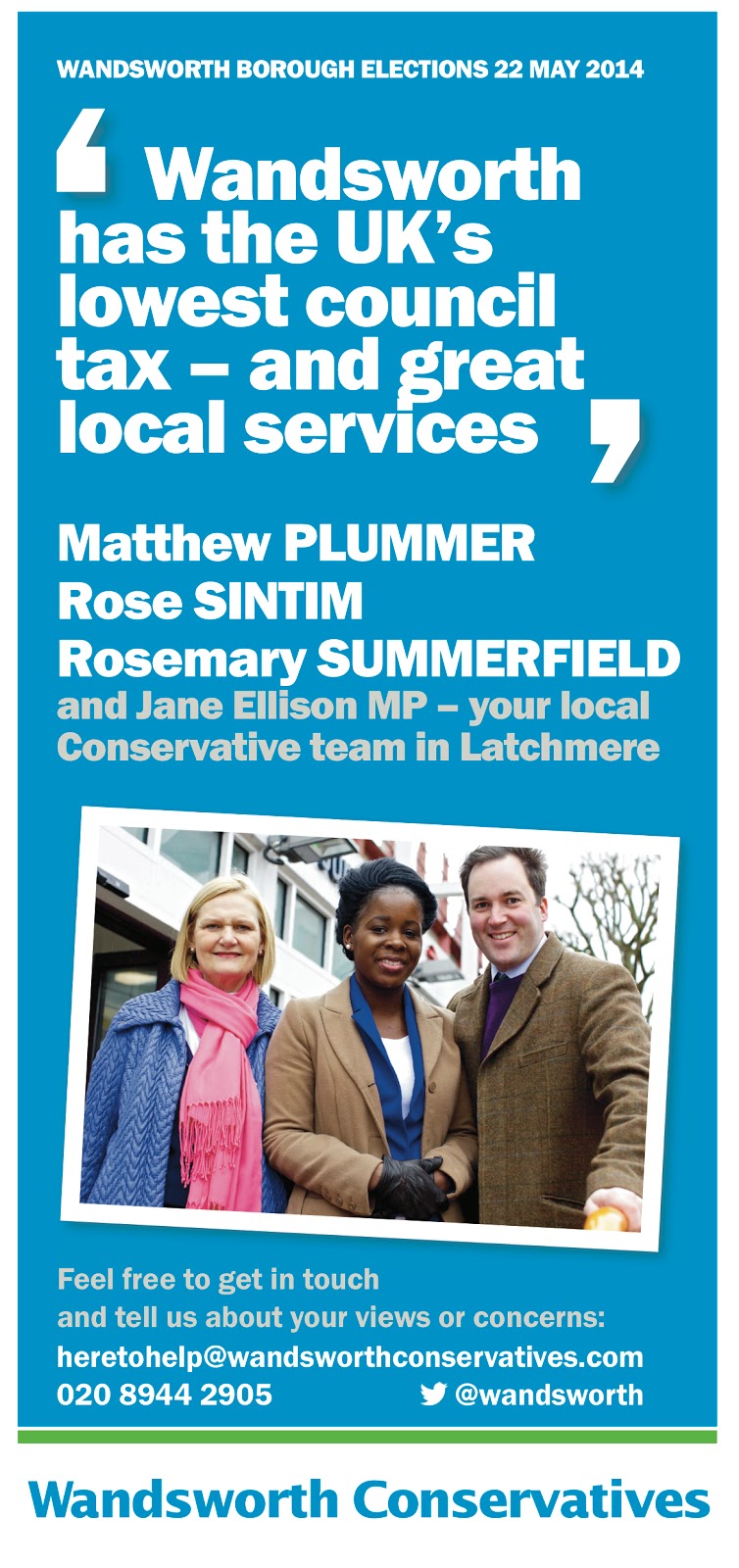
Back in February I was selected to be one of the Tory candidates in Latchmere, a ward in Wandsworth that encompasses the area just to the north of Clapham Junction station. It'll be a tough campaign as the seat has – to my knowledge – been Labour heartland since time immemorial.

That said, we're in with a fighting chance, as the Conservatives in Wandsworth have a fantastic track record, with outstanding local services and the UK's lowest average council tax. Crucially we have very little debt – something achieved on the back of prudent management since we took control of the council back in 1978 (when I was born!). If the rest of the country could see how we ran the council then Labour wouldn't even have the faintest sniff of a chance in the national elections. Our low council tax is a huge help to the most disadvantaged in the Borough, as the council tax reduction that central government gives the disabled means they effectively don't pay a penny.

For those of you who are interested (there will be some, I know!) here's the freshly designed calling card we're going out campaigning with tonight.

25 February 2014

'Everybody rides now: the most fashionable people have taken it up!'

This is an essay I wrote during my final year as a undergraduate at UCL, and it might be of interest to anyone interested in a previous boom era for bicycles in the capital.

---

How was cycling in London represented and debated in contemporary texts and illustrations of the late 19th and early 20th century?

I'm interested in how cycling was portrayed in the period between the late Victorian era and the start of the Great War, a time during which cycling moved from relative novelty to an accepted part of London's transport landscape – and a far cry from the advent of the velocipede half a century earlier, when ugly scenes were common: 'In London, one unfortunate 'velocipeder' found himself surrounded by a hostile mob. He frantically hailed a stagecoach, flung his machine on its rooftop, jumped in, and sped off to safety (Herlihy 2006:34). More worryingly, the London College of Surgeons had spoken out against the machines which were 'dangerous to the rider and likely to cause 'ruptures': only a fool would persist' (2006:38).

The 1880s saw the bicycle evolve from being a 'boneshaker' into something with which today's machines share a clear lineage, and Rubenstein identifies two important innovations that brought about the transformation. John Kemp Starley's 'Rover' safety bicycle (illustration 1) had both wheels of similar size, a feature that was advertised as 'set to fashion the world' (1977:48) after it was launched in 1885, with its diamond-shaped frame saving riders from 'mounting a thing like a giraffe, from which an impromptu descent offers unpleasant possibilities' (Herlihy 2006:167). Likewise Dunlop's pneumatic tyre dominated the market after it was introduced in 1888, and Rubenstein argues that these improvements meant that 'cycling could become a method of transport and recreation suitable to both sexes and most ages. Men and women who sought increased social emancipation were eagerly and gratefully to take advantage of what invention and mass production made possible' (1977:48). No longer a curiosity, bicycles were ready for the masses.

Illustration 1: John Kemp Starley's 'Rover' safety bicycle
(Coventry Transport Museum)

These innovations helped facilitate increasingly impressive feats of athleticism. Events that pitted cyclists against horses remained popular until relatively late in the day – English champion David Stanton famously taking on a trap drawn by 'Lady Flora' and her driver Mr. MacDonald at Alexandra Palace in 1875 (Herlihy 2006:165). However Stanton also raced in that same year between London and Bath, covering the distance in just under 12 hours, and demonstrating that bicycles were going to be a realistic transport proposition for many (Herlihy 2006:179). 20 years later Wandsworth's 'Grove Cycling Club' was holding weekly rides of 30-50 miles into the Surrey Hills (illustration 2), which would have been made much easier by the developments in bicycle technology in the intervening two decades.


Illustration 2: The 1897 fixtures card for Wandsworth's 'Grove Cycling Club'
(Museum of London)

Social acceptance of the bicycle was transformed in the last decades of the 19th Century, and Rubenstein describes how in 1895 'popularity became passion', with the ladies of London's high society transforming attitudes towards bicycles amidst a wider bicycle craze. This change was noted by Victorian cycling journalist Constance Everett-Green, who observed that 'it would hardly be too much to say that in April of 1895 one was considered eccentric for riding a bicycle, whilst by the end of June eccentricity rested with those who did not ride.' (Rubinstein 1977:49). Horrall notes that even the least athletic Londoners were keen to be associated with cycling: 'the rotund Sir Augustus Harris, the legendary manager of the Drury Lane Theatre who had created the modern Christmas Pantomime, was photographed outside his home dressed in a business suit leaning uneasily against a bicycle' (2001:55). Women speeding around on two wheels did – however – raise some eyebrows, with Herbert Barrs writing a musical comedy called 'The bicycle girl', which he subtitled salaciously 'The scorcher'! (Horrall 2001:55).

Rubinstein estimates that this period would have seen about 750,000 bicycles built annually, with the number of cycle manufacturing and repair businesses in London growing from 54 in 1889 to 390 in 1897 (1977:53). Despite ebbing popularity after the 1895-97 boom, cycling remained commonplace, with business confidence in the industry holding up, particularly given that 'the cheap mobility offered by bicycles, specially in emancipating women, was resolutely most popular with the lower middle classes' (Horrall 2001:60-61).

This sense of freedom runs through a wonderful interview the Manchester Guardian's correspondent conducted with John Burns (Independent Socialist MP for Battersea) at the start of the 1900 General Election:
Anxious to see Battersea on the eve of the greatest struggle in its history, I had ridden south-west to the silver Thames, crossed that beautiful park, with its smooth roads, its ample playing fields, and large calm waters, and had emerged in the Battersea Road (The Guardian: online).
The journalist's choice of words are incredibly evocative of freedom and effortless transport in a city that was growing rapidly, and over a century later they still place me firmly in the saddle of a bicycle, particularly as the piece continues:
He was riding towards me on his bicycle, the handlebars decked with a bunch of blue and white ribbons; alert, robust, radiant with confident strength. He greeted me with a gay smile, and, riding side by side, we left the crowds of his too urgent followers and glided into a quieter street (ibid.).
These passages suggests that the roads of Battersea were smooth and well maintained, which adds to the sense of working class pride in the area being toured, with the journalist adding that 'there is little or no squalor, and in this district in the Shaftesbury estate you have a model of how poor men should live well - small, neat cottages, prettily built, each with a gift of "home" for the occupants' (The Guardian: online) – all very much in keeping with the newspaper's socially progressive outlook. Here the bicycle is an accepted, inconsequential part of city life – even with Burns' ribbons festooned on his bicycle – but it also an important tool for the London correspondent's carrying out his daily rounds: this ability to move around the city is highlighted by the description how the pair 'left the villas, crossed the main road and entered the working-class district with that swiftness of transition which makes life on a bicycle so vastly exhilarating and entertaining' (ibid.). The passage also points out how bicycles are able to break down social barriers as they enable people move (and see) other parts of the city far more easily than if they were on foot.

As a cycling member of parliament Burns was able to cover his constituency quickly, and this helped him to build his reputation as one of London's great MPs – he represented Battersea from 1892 to 1918, and today one of the Woolwich ferries is named after him. But the ability to cover ground also meant he was the first on hand when a woman died from heat exhaustion in Battersea Park in 1896 (see illustration 3).

Illustration 3: The death of Mrs. Hodgkins, erroneously depicting a policeman as the first to offer assistance
(Illustrated Police News)

However the cover mistakenly has a policeman assisting the dying woman, which was incorrect:
It was not a policeman named Burns, who first went to the assistance of the unfortunate lady, but John Burns, the member for Battersea, was but a few yards distant, and as might be expected, he at once endeavored to render what help he could, but alas! it was already too late to render any material assistance. (The Wheelwoman and Society Cycling News 1896:15)
The picture shows a rider – presumably male, given the practical clothing – disappearing off in the distance, and this suggests that by 1896 women were able to ride alone without raising eyebrows. Alternatively the point could be somewhat more barbed: despite the freedom of being on two wheels, society is still leaving women behind, encumbered with expectations that are far short of reality. Regardless, the event was reported by the 'Wheelwoman and Society Cycling News' as a 'warning at the heads of wheel women, not to cycle during hot days', with the journal advising that:
Unsuitable clothes, combined with too tight corsets, were more to blame perhaps than the heat. There is nothing more fatal to the health and comfort in cycling than tight lacing, and yet hundreds of women, to whom Nature has been kind in giving them good figures, torture themselves and all lovers of beauty by cramping themselves into clothes that are many inches too small for them. (The Wheelwoman and Society Cycling News 1896:6)
The Illustrated Police News – a cheap weekly tabloid – was notorious for its sensationalized coverage of late Victorian society, and its depiction of the last moments of Mrs. Hodgkins is highly dramatic, yet rich with detail: the details of her corset are captured, as is the shocked expression on the onlooking' faces. There is a tragic contrast between the practicality of her bicycle – with skirt protector covering the rear wheel and chain guard protecting her from grease – and the billowing clothing she is wearing. While her outfit seems impractical to the modern eye, the contemporary report suggests that her dress sense on two wheels was commonplace, and that Mrs. Hodgkins was merely unlucky to be be afflicted by the heat. Indeed, contemporary issues of the Illustrated London News carried advertisements for tailor-made women's cycling clothing (illustration 4), although this still looks constricted, suggesting that practicality came second fiddle to fitting into late 19th Century London's social norms. It is encouraging to see that the Wheelwoman and Society Cycling News's report encouraged women to dress practically, and not for broader social expectations. 118 years on I imagine a comparable journal today would be firmly behind people wearing lycra on their ride to and from work!

Illustration 4: Women's cycling clothing in the mid-1890s
(Illustrated London News)

Despite this tragic episode, Horrall's argument that bicycles were particularly significant in the emancipation of women is borne out by contemporary material. Elizabeth Robins Pennell was an American woman who lived in London for 30 years, and from 1884 she embarked on a series of adventurous cycle tours with her husband – first to Canterbury, but increasingly further afield, including “Berlin to Budapest on a bicycle' in 1892 (illustration 5). These were published in the Illustrated London News, and her accounts would have fired up London's women to greater degrees of independence – after all, if the author could handle Berlin's railway porters the readership would have no trouble with adventures closer to home. And her male audience would also have been impressed with her exploits – Robins Pennell wrote in the first person, clearly distinguishing her experiences from those of her husband Joseph when she writes 'I have told J––––'s story of his adventures by the way; now I must tell you mine' (Robins Pennell 1892:766). This clear assertion shows that she was her own woman, and her cycling adventures around London and further afield were part of her independent image.

Illustration 5: Berlin to Budapest on a bicycle (Illustrated London News)

Back in London Robins Pennell entertained the likes of Oscar Wilde and George Bernard Shaw (Bertelsen 2009), suggesting that she was something of a celebrity journalist, and a trendsetter among London's women cyclists. Robins Pennell was certainly a keen advocate of following cycling technology, having switched in 1886 from a two-person tricycle that she shared with her husband to an early single person safety bicycle (Zheutlin 2008:33). Together with women like Annie 'Londonderry' Cohen Copchovsky (the first woman to 'ride' around the world) Robins Pennell fired up the imagination of the growing suffragette movement back in London, and entwining an enjoyable means of transport around London with the politics of women seeking the right to vote.

By 1898 the suffragette Frances Abbott was in a position to write:
I have lived to see the woman who never wished her daughter to have a bicycle ride a wheel herself in company with that daughter; and when I ventured to recall her former opinions she said with unblushing serenity: ‘Oh, well, everybody rides now; the most fashionable people have taken it up; there is really nothing like it’, and she began to chide me because I did not own a wheel. (1898:150)
The early 1900s saw a renaissance in the women's suffrage movement, and its campaigns produced highly evocative material that aimed – with varying degrees of subtlety – to make the case for female enfranchisement. The National Union of Women's Suffragette Societies (NUWSS) made long journeys to London by bicycle, and Illustration 6 shows the successful women of such a ride in 1913 surrounded by others in the movement. It portrays them in a manner similar to regimental and sports photos, and photographs like this demonstrate both the resilience and adventurousness of these women in making such a long ride, set in terms that men – used to team photos – would appreciate. The banner also lays down a direct challenge, explicitly pointing out that women have achieved something that only a few decades earlier would have been an accomplishment for the likes of champion rider David Stanton.

Illustration 6: NUWSS Land's End to London ride (The Women's Library)

Photographs were used to present reality and challenge conservative thought, but the early 1900s saw also propaganda artwork from the likes of the Artist's Suffrage League, which was based in Chelsea. 'Young New Zealand' (Illustration 7) points out that women in the newest of the Empire's Dominions had enjoyed universal suffrage since 1893. The poster taps into the public's acceptance of women cyclists, with a girl representing 'Young New Zealand' dressed in practical clothes, rather than the excess that seemingly did for Mrs. Hodgkins. And by having her hand in her pocket the poster suggests the girl has a laid back mastery of her machine, as poking fun at the social expectations of the 1900s – represented by the hatted man.

Illustration 7: Artists' Suffrage League propaganda from 1907 (Museum of London)

But it also plays on the evolution of the bicycle, as anyone walking out of the Artists' Suffrage League offices on the King's Road would have waited a long time for a penny farthing to pass by – by that point they were obselete. The limited enfranchisement of British women to vote in municipal elections in 1907 is acknowledged by the small rear wheel of the penny farthing, but the ungainly appearance of the man riding his bicycle rams home the Artists' Suffrage League main point – not giving women the vote smacks of the 1880s, a bygone era.

Looking back over the contemporary material bicycles clearly represent the zeitgeist of London during the late Victorian and Edwardian eras. Cycling tapped into the British spirit of industrial innovation, with the pneumatic tyre making riding on two wheels something for all, rather than a few hardy souls capable of enduring the 'boneshaker'. But they also represented social change, with the surge in 'wheelwomen' initially demonstrating that they were more than capable of exercising the freedom inherent in riding a bike, and subsequently pouring fuel on the nascent suffragette movement.

Yet the idea of a cycling 'craze' seems a little hard to reconcile. Certainly bicycle popularity exploded in the mid-1890s, but it was a popularity that endured well into the era of the motor car, and looking at the material a century later it is easy to match the sensationalist, judgmental coverage of Mrs. Hodgkins' death with that of the spate of cyclist deaths in late 2013, and the sometimes excitable coverage that bike riding received in London's media – much in the spirit of the Illustrated Police News.


References

Abbott, F. (1898) ‘A comparative view of the woman suffrage movement’ North American Review 166(495) p.142–152

Anonymous (1896) The Wheelwoman and Society Cycling News, 1st August p.6, 15. Available at: http://www.newspapers.com/newspage/34415508/ [Accessed: 11 Jan 2014].

Bertelsen, C. (2009) 'A greedy woman: the long, delicious shelf life of Elizabeth Robins Pennell' Fine Books Magazine, 44 Available at: http://www.finebooksmagazine.com/issue/200908/pennell-1.phtml [Accessed: 12th January 2014].

Herlihy, D. (2006) 'Bicycle: the history' New Haven: Yale University Press

Horrall, A (2001) 'Popular culture in London 1890-1918: the transformation of entertainment' Manchester: Manchester University Press

Robins Pennell, (1892) 'Berlin to Budapest on a Bicycle' Illustrated London News 1892:766

Rubinstein, D. (1977) 'Cycling in the 1890s' Victorian Studies 21(1) p.47-71

The Guardian (1900) 'A bicycle interview with John Burns, Battersea's man to beat' London: The Guardian Available at: http://www.theguardian.com/theguardian/2012/oct/02/john-burns-battersea-cycling-archive-1900 [Accessed: 9th January 2014].

Zheutlin,P. (2008) 'Around the World on Two Wheels: Annie Londonderry's Extraordinary Ride' New York: Citadel Press

19 February 2014

A gigantic shunting of workers

Last week the Office for National Statistics published research that found commuters who spend between 60 and 120 minutes travelling to work have lower life satisfaction, see their employment as less worthwhile, have lower happiness levels and greater anxiety. This in itself is hardly surprising, but it is useful to be reminded by hard data that ‘commuting is clearly and negatively associated with personal well-being’. Unsurprisingly the research suggested that people who work from home as the happiest: I’m self-employed, and the rare occasions I’m rammed into a rush-hour Northern Line train remind me just how lucky I am to avoid the daily grind on the underground.

Commuter at Waterloo
Our enthusiasm for commuting over long distances owes much to our historically excellent infrastructure, but also the failure to make modern city life accord with modern needs – not my words, but those of The Spectator back in 1964, which recognised that the ‘gigantic shunting of workers across the London conurbation’ was batty. This is particularly so when you recognise that drivers pay hefty fuel bills and require government to build costly roads, and that railway commuters need billions spent on capacity solutions like Crossrail (and Crossrail 2) while paying eye-watering amounts for season tickets. If your daily commute is an hour each way every day of the week, come Friday you’ll have lost a cumulative working day paying for the privilege of sitting in a traffic jam with cyclists whizzing past you. Personally I’d rather spend my time with my family and friends, rather than listening to Southern tell me that yet again they ‘are’ sorry to announce that blah, blah, blah.

For many people the daily pilgrimage to work is an unwitting yet rational response to decades of poor urban planning. Escaping to the countryside to exercise what Nick Boles describes as ‘a right to a home with a little bit of ground around it to bring your family up in’ is perfectly reasonable given some of the shocking housing built across the country in recent decades. After all, if your home is little more than a shoebox, having a garden for your children to play in is very sensible!

Yet ripping up the green belt to build garden cities simply compounds the cost and misery of commuting. Instead we need higher-quality housing in London and our other urban areas that entices people into living closer to where they work, and to challenge what the ONS describes as ‘inertia’ towards our rigid commuting patterns. Historically Britain’s inner city areas were much more densely populated than the leafy outer suburbs: today the reverse is true.

Fortunately there is hope. New homes are being built at sites like Battersea Power Station to higher design standards, and there is a renewed interest in promoting walking and cycling to work. And adopting new guidelines like ‘Building for Life 12′ means that for the first time in decades we are taking significant steps to avoid blighting lives at the planning stage with the expense and wasted hours of traffic updates and platform announcements – with which the inhabitants of our existing garden cities are only too familiar.

First published by Platform 10 on February 19th, 2014

22 November 2012

In praise of red tape

Two small stories made the news last month. The first was a report by Ipsos MORI for the Royal Institute of British Architects, which found that many of the UK’s new-build homes are poorly designed, with chaotic living spaces for the families that the large housebuilders seduced into buying them. Complaints abounded of homes without internal storage for everyday things like vacuum cleaners, and rooms fitted with the legal minimum number of power sockets, despite this being the age of the iPad and countless other electronic gadgets. Ipsos MORI’s Ben Page was damning about the quality of the homes being built in the UK, stating that the report ‘shows just how cramped and poorly planned much of our housing is today, and the extraordinary lengths people go to cope with it.’ RIBA rightly pointed out that our building regulations are in desperate need of modernisation.

The second story concerned the latest in the Coalition’s ongoing efforts to address the UK’s housing shortage. You can debate whether this is because of the banks’ lending policies, the Labour government’s immigration policy, raw material costs, etc. ad finitum: the simple reality is that we need more homes. The government announced that a new body has been tasked with looking at how housing standards could be simplified, and aims to tackle what (then Housing Minister) Grant Shapps dubbed the ‘alphabet soup’ that is the building code. Which sounds like the positive action we want from politicians, until you realise that it isn’t a bonfire of regulations that is needed, but the somewhat more painstaking job of tightening and fine-tuning our minimum standards for the new wave of homebuilding that the Government wants to unleash.

None of this is news to our leaders. Back in 2007 the Shadow Cabinet was presented with the far-sighted 'Blueprint for a Green Economy', which recognised that ‘building control and planning systems should be more closely integrated as they are in fact two sides of the same coin’. The demands we place on our living spaces haven’t changed much since then, and it is worth considering that the current offering from the building industry isn’t exactly popular. Currently only one in four home buyers would consider a new-build property, so clearly something isn’t right, as consumers generally prefer new things. If the government merely decides to axe energy efficiency requirements and other quality of life regulations in an effort to get house building going at the lowest possible price, they will be making a bad situation a whole lot worse. Why should the striving classes who will have to live in these new properties face needlessly high heating bills and cowboy home design? I prefer to be optimistic though: there is now a golden opportunity to ensure that new homes are built with sustainable systems like rainwater harvesting, which offers a return on investment well before the halfway point in a 25 year mortgage and reduces the need for costly utilities infrastructure in years to come.

I mention this episode merely because the War On Red Tape™ is back in full swing this week, with the announcement that the planning appeals process is to be streamlined. The PM is 'getting a grip' on the issue, and the government’s narrative sets the frustrated developers who wish to drive the nation’s growth forward against the Nimbyism and regulatory fat that is clogging up the economy. Cutting regulations makes for a good sound bite, and shows politicians as battling the morass of building paperwork that stands in the way of the slow march to economic recovery.

Except this simply isn’t true. Ignore the fallacy that home-building delivers economic growth (it does, but only in the very short term, with the main beneficiaries being the shareholders of the large housebuilding companies, the farmers keen to cash in and flog their productive lands, and the migrant EU workforce needed to deliver the boom in construction). Appealing planning decisions is incredibly important to sustainable, harmonious communities.

For example, Conservative Wandsworth (my local authority) is an exemplar council: its reputation for competence regularly sees wards that vote Labour at general elections returning a full complement of Tory councillors at the local elections. Wandsworth has campaigned tirelessly against a 1,200 home development located well beyond reasonable walking distance to our local railway stations, with the local road network already desperately congested, as anyone who has battled their way down Trinity Road knows only too well. The appeals process has allowed Wandsworth Council to whittle down the ambitions of the developer to less disastrous levels, and highlights the importance of letting communities put their case and balancing the steamroller effect of the big developers’ deep pockets. Often projects are improved as designs are scrutinised, with the final blueprints gaining far greater acceptance from all sections of society – and surely this is a good thing?

There is also a broader, more philosophical point. We Conservatives believe in the power of the individual and society, not the blunt tools wielded by the big state, which is fortunate as the number of applications for judicial review in planning cases has dropped since 2006 – the rocketing 11,000 applications figure mentioned by the PM in his speech driven by immigration, that other political bête noire. Cherrypicking statistics belies the reality, and writing in Monday’s Guardian, Sir Jeffrey Jowell QC hailed the evolution of British administrative law since 1945 as a major achievement, and one that is in fine health today. Compare this to the confidence in our political system, which many of the public feel increasingly estranged from.

So here lies the danger. How much more alienated will the ‘little people’ far removed from Westminster or even just their local town hall feel when the government has lengthened the odds in their fight against the ruthless calculations of the circling developers? Regulation might feel like a brake on our economy, but it is the price we pay for people believing that they are part of an inclusive society. The general public’s simmering fury over the fast tax practices of Amazon, Starbucks, and other big businesses is a warning that politicians can ill afford to ignore.

First published by Platform 10 on November 22nd, 2012